
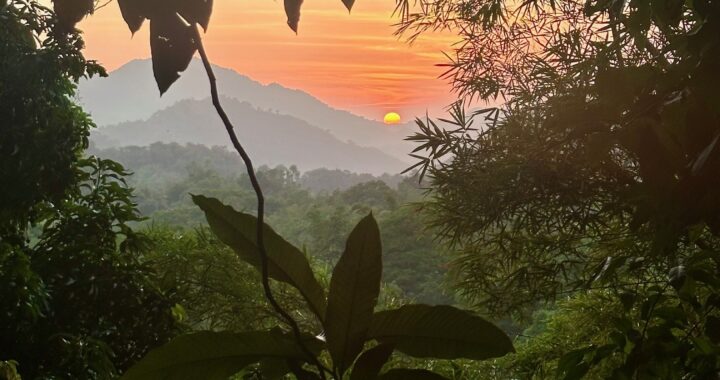
The road from Santa Marta begins in heat and noise, but it doesn’t take long before the air shifts. The climb into the Sierra Nevada de Santa Marta softens everything: the light, the temperature and the environment transforms. The jungle thickens around each bend as you climb the hill further from the noise and traffic surrounding Santa Marta.
Less than an hour from the coast, Minca sits high in the hills, a world apart from the bustle below. Where Santa Marta hums with beach traffic and heat, Minca is cooler, greener, and slower; a small jungle village shaped by waterfalls, trails, and a deep sense of stillness. It’s also rich in indigenous history, though what you feel most immediately is the dense and wild landscape.
We spent five days here, wandering between trails and the town, letting the rhythm of the place take over.
Minca consists of a handful of streets, a small square and park, a church, a scattering of cafés and restaurants; some traditional, others clearly shaped by the steady flow of travellers who now pass through. It’s undeniably beautiful, but also definitely popular. Younger travellers gather for sunset drinks, music drifts from jungle bars, but tucked among it all are quieter corners where daily local life carries on as it always has.
But it’s when you leave the village that Minca really reveals itself.
Various paths slip into the forest almost immediately, leading you into thick green where the air feels heavier, and the sounds sharpen. Minca is abundant with trails to explore with your family. The walks are not overly technical, but they demand effort, especially in the heat, and especially with children. Hills rise quickly, and distances can feel longer than they appear on a map. Moto-taxis regularly pass, offering a shortcut up the steepest sections; tempting, particularly with tired legs. We took advantage of the moto-taxis one day to shorten our climb towards the popular Pozo Azul.
Water is never far away. You hear it before you see it.
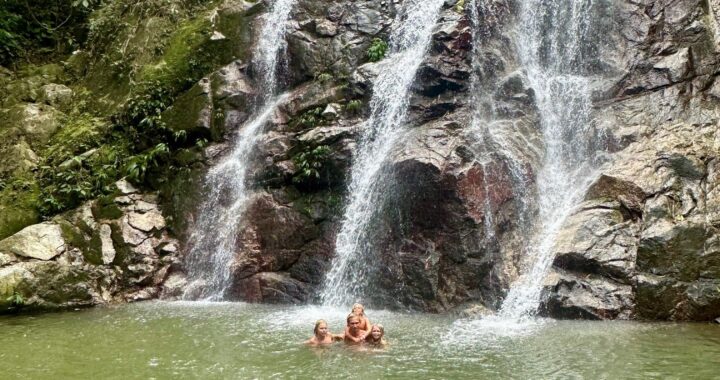
At places like Oido del Mundo, about a two-kilometre walk uphill from town, the forest opens to reveal a quieter, more intimate cascade. We arrived early, paying a small entrance fee (10,000 COP each), and for a while had it entirely to ourselves; a rare kind of stillness, broken only by the sound of falling water. It felt untouched, simple and real.
Other trails and waterfalls are more developed. Marinka Waterfalls, a longer and more established walk, offers designated paths and swimming areas, even a restaurant and floating platforms. It’s easier in many ways, but busier too. For us, it lacked some of the rawness that makes Minca special.
Then there’s Pozo Azul; perhaps the most well-known of them all. We visited over the weekend and found a steady stream of people heading in the same direction. On the way, we had a tip off from a friend to stop at a quieter, lesser-known fall located at Camping Amazilia, and it proved worth it; a reminder that in Minca, the best moments often come slightly off the main path.
Beyond the waterfalls, the hills are dotted with fincas, coffee and cacao farms where time seems to slow even further. At places like Finca Arhuaca, the process unfolds without urgency: cacao beans drying in the sun, machinery humming steadily, stories shared in a way that feels more conversational than instructional. For children, it’s not about understanding every step; it’s about seeing, tasting, and connecting with something tangible. We organised a cacao tour in town with Jorge. He provides authentic, eco-conscious tours. (Instagram at Amayana_experiences for more info).
The main street offers a variety of traditional restaurants blended with modern eateries. In the heart of the village, Panadería La Miga is a firm traveller favourite and an easy morning meeting spot. Over fresh bread and strong local coffee, plans are made, routes are shared, and the day begins at Minca’s unhurried pace.
Lunchtime meals are simple; often a menú del día, fresh being the most affordable and available at many restaurants across town.
As evenings arrive quickly and the light fades behind the mountains, birds cross overhead on their way home, and the energy softens. Minca’s evenings are low-key but surprisingly varied; wood-fired pizzas, fresh pasta, and lively taco spots all within a few streets. Places like The Lazy Cat draw a crowd at sunset, while smaller spots tucked along the main road offer something quieter, where dinner stretches out as slowly as the day itself.
For those who want it, there’s still a livelier side; sunset spots with music drifting through the trees, drinks in hand, the sky opening wide over the hills. Even just climbing the steps to one of the higher viewpoints for a drink can be enough: the light fading, the jungle stretching out below and the sense of being far removed from everything else.
We stayed in a small cabin at Bosque Azul, tucked close to the river and just a short walk from the centre of town. It proved an ideal base; perfect for setting out on early walks and returning for a cooling dip as the day’s heat began to build.
Beyond this, Minca offers a range of places to stay, from simple hostels in the village to eco-lodges hidden in the surrounding hills. Mundo Nuevo Eco Lodge and Jungle Joe’s Ecolodge sit just outside town, trading convenience for sweeping views and a deeper sense of privacy. Closer to the centre, Casa Loma Minca has a more social, laid-back feel. Places like Mincaecohabs Hotel offer a more comfortable stay, with private cabins nestled within the forest canopy.
The roads can be rough in places after rain, and cash is essential; there’s no reliable ATM, just a small shop that offers cash back with a fee. The heat, maybe less than the coast, can still be intense on the climbs, making early starts the best option. Insects are part of the experience, and after a few days, we understood exactly what was meant by “Minca Legs”!
With younger children, the terrain requires a bit of planning; some uneven paths and long stretches without facilities. But for families, that’s also part of the appeal.
With a bit of preparation, Minca offers something increasingly rare: space. Space to move, to explore, to let children be active and curious without structure or pressure. For older children, it provides freedom.
For younger ones, it’s an adventure; waterfalls, trails, river dips, and the simple joy of being outdoors. Weekends bring local crowds to the rivers, gathering in shaded spots and the nearby restaurants, adding a different kind of energy to the landscape.
Most people stay only a few days. We stayed five nights, which let us explore some highlights, but you could easily stay longer.
Most people will start their journey with a stop in Santa Marta. Reaching Minca is part of the transition. From Santa Marta, the journey begins in heat and noise, before climbing steadily into the Sierra Nevada. Whether by shared colectivo from the market or a taxi winding up the narrow road, it takes less than an hour for the air to cool and the pace and crowds to soften.
The drive to Santa Marta takes under an hour, leaving the slower pace of life in Minca and descending the winding road back towards the coast. If you’re in Santa Marta, and have a few days spare, we would highly recommend visiting Minca!